Every chapter of this book ends with a single italic line placing itself on one calendar year. This is that year.
The reason for it is a problem the book runs into on its first page. Large numbers do not work. Four billion years and four hundred million years are read the same way by the mind, which is to say not at all. The eye passes over both and registers only a lot. A figure that cannot be felt cannot do any work in a sentence, however accurate it is.
So the whole history of the Earth is pressed into a single year. The planet forms at midnight on January 1. The moment you are reading this is midnight at the end of December 31. Everything that has ever lived (every species, every extinction, every ancestor of yours) fits inside those twelve months.
What a calendar unit is worth
| One day | about 12 million years |
|---|---|
| One hour | about 514,000 years |
| One minute | about 8,500 years |
| One second | about 143 years |
Two abbreviations, before we start
They appear on the diagram below and at the foot of every chapter, and they are worth thirty seconds:
| bya | billion years ago. So 3.8 bya is three point eight billion years before now. |
|---|---|
| mya | million years ago. So 485 mya is four hundred and eighty-five million years before now. |
They are the ordinary shorthand, used here for an ordinary reason: the full phrase will not fit at the end of a line.
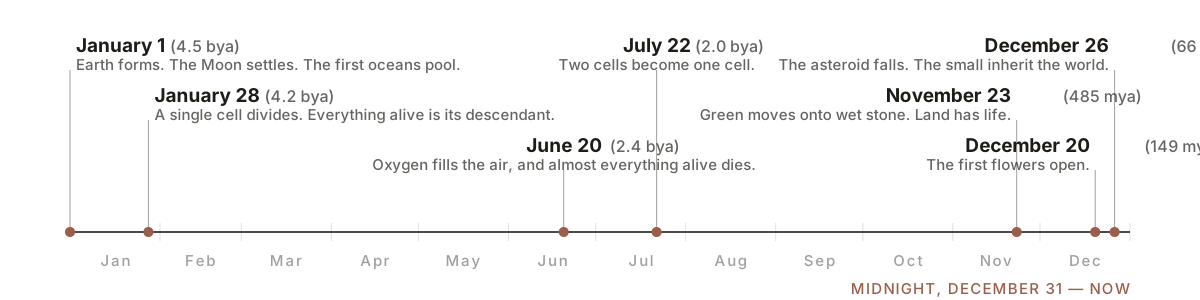
Every mark carries both: the calendar date and the real figure in parentheses. That is deliberate, and the two are doing different jobs. The date is the part you can feel. A year is a length a person has actually lived through, so the land was bare until late November lands somewhere a number cannot reach. The figure in parentheses is the part that is true. Keep them side by side long enough and the second one starts to inherit the weight of the first.
The year
Read it slowly, because the shape of it is the argument.
Life shows up almost at once: January 28, 4.2 billion years ago, with eleven months still to run. Then it stays single-celled and small for an extraordinarily long time. The air does not become breathable until June 20, 2.4 billion years ago, and it becomes breathable by killing nearly everything then alive. Two cells merge into one on July 22, 2 billion years ago, which is where every plant, every animal and every fungus begins. And the land (the whole visible world, every forest and grassland you have ever stood in) stays bare rock and water until November 23, a mere 485 million years ago.
Flowers open on December 20. There are eleven days left in the year.
Notice what the parentheses do to that last sentence. Eleven days sounds like the end of something. 149 million years sounds like a geological era, which it is. They are the same fact, and you need to hold both to see the shape of the year at all.
December, and the afternoon everything turned
The last month is crowded enough to need its own strip.
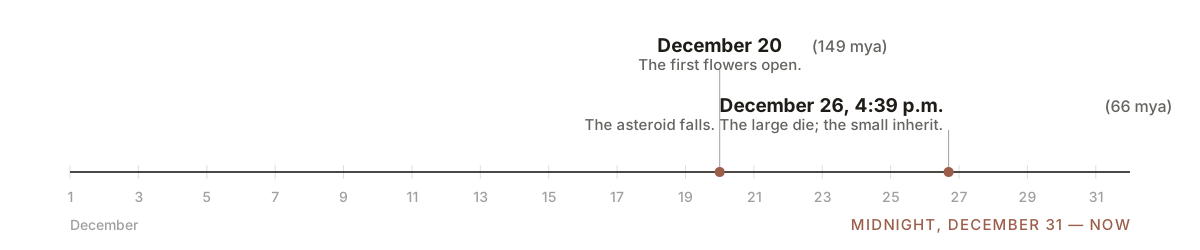
Six days after the flowers open, at about twenty to five in the afternoon on December 26, 66 million years ago, a rock arrives.
Everything large dies. What comes through are the small things: burrowers, night-feeders, animals already in the habit of staying out of the way. Warm-blooded, insect-eating, unimportant. For well over a hundred million years they had been a minor detail in a world that belonged to something else, and in one afternoon the something else was gone and the detail inherited the ground.
That is the animal at the far end of your family line, and a mouse's.
Nothing about this was owed to us. Move that afternoon (a different angle, a different ocean, the same rock eleven minutes earlier or later) and there is no particular reason the last five days of the year should run the way they did. Whatever else we are, we are not the thing the story was heading toward.
We are what happened after the accident.
And then December 31
Everything human is inside the final minutes, which is why the last day needs its own picture.
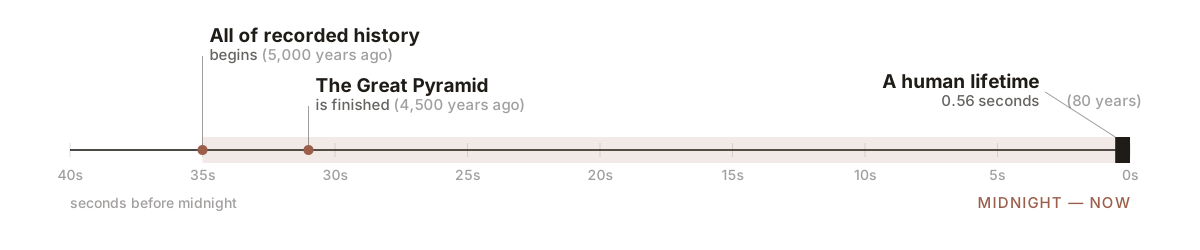
All of recorded history (every language written down, every empire, every book including this one) is the final thirty-five seconds. The Great Pyramid is finished with about thirty-one seconds left on the clock.
A human lifetime is half a second.
This is not offered as a way of feeling small. The point of the calendar is not that we are brief; it is that the twelve months in front of the last minute were not empty, and are not background. They are the thing the book is about, and we arrived at the very end of them holding the only pair of eyes that can see the whole year at once.
Where it comes from
The device is Carl Sagan's. In Cosmos he compressed the age of the universe into a calendar year, and the Earth does not form until September on that version, with all of life crowded into the final quarter.
This book rescales it (same idea, different clock) from the age of the universe to the age of the Earth, so that the history of the web of life takes up the whole twelve months rather than being compressed into the last few weeks of somebody else's calendar. It is a book about life, so life gets the year.
The marks on the diagram above are the ones the book has placed so far, and there are more coming: a chapter is not finished until it knows its date. The letters will carry each new one as it lands.