A Tree Is Made of Air
Knock on the nearest piece of wood: a table, a door, a chair, the handle of something.
It is hard. Solid, through and through. You could stand on it. If it were a beam, it could hold a roof over your head for a hundred years without complaint.
Here is the question. Answer it before you read on.
Where did all that weight come from?
A full-grown oak weighs several tons. Every ounce of it was assembled by the tree, out of something. So: out of what?
Nearly everyone says the soil. The tree stands in the ground. Its roots reach down. The ground is where the food is. You picture a plant drinking up dirt and turning it into itself. It sounds obvious. For two thousand years, it was the answer educated people gave.
It is wrong. One man proved it with a bucket, a young tree, and five years of patience.
The willow in the pot

In the early 1600s, a Flemish physician named Jan Baptist van Helmont decided to settle the question by weighing it.
He took a large pot, filled it with soil he had dried out, and weighed it carefully: two hundred pounds. Into that soil he planted a young willow, which he had also weighed: about five pounds. Then he did nothing clever at all. He watered it, and he waited, and he kept the pot covered so that no dust could blow in and spoil the accounting.
He waited five years. Nothing clever. Just water and time.
At the end of it he pulled the willow out and weighed it again. It had gone from five pounds to something over a hundred and sixty. A hundred and sixty pounds of new tree. Trunk, branches, bark, leaves, roots that had not been there before.
Then he dried the soil out again and weighed that.
It had lost about two ounces.
Sit with those two numbers for a moment, because they do not fit together at all. The tree had gained a hundred and sixty pounds. The soil had given up two ounces. Whatever the willow built itself out of, it had almost entirely not come from the ground it was standing in.
Van Helmont thought it must have come from the water. Water was the only thing he had added. He was wrong about that too. But he was wrong in a more interesting way than everyone else. He was wrong on the strength of a measurement. That is the only respectable way to be wrong.
The real answer is all around you
The tree built itself out of air.
Out of carbon dioxide. A gas that makes up a small part of the air. It is drifting through the room you are sitting in right now. A leaf is covered in thousands of tiny mouths, called stomata, which open to let that gas in. The tree takes the carbon out of it and bolts those carbon atoms to each other, again and again. When this happens enough times, you get wood.
That is where the weight came from. Not up through the roots. In through the leaves, out of the sky, as a gas you cannot see.
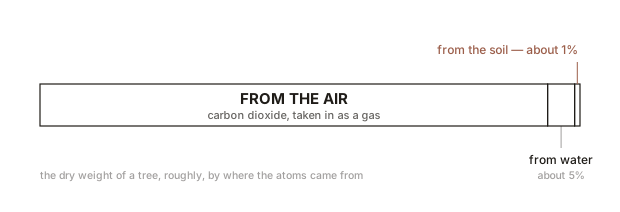
The roots are not useless. They bring up water, which the tree needs and which supplies the hydrogen. They also take up minerals like nitrogen, potassium, and magnesium. These are the things fertilizer is made of. They matter a lot. A tree that does not get them will sicken and die.
But by weight, these minerals are almost nothing. The wood is made from sky.
How a leaf does it
Here is the machinery, in plain words. It happens in every green thing you have seen. It is happening right now in any houseplant in the room.
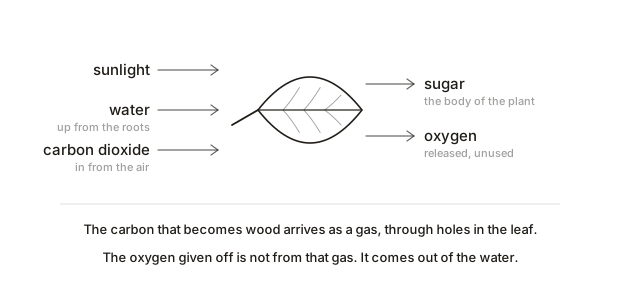
Sunlight hits the green stuff inside a leaf and knocks electrons loose. The leaf uses that stolen energy for two jobs at once.
The first job is to split water. Water is two hydrogens and an oxygen; the leaf wants the hydrogen and the electrons, and it takes them. The oxygen is left over. The leaf has no use for it. It lets it go out through the same small mouths that let the carbon dioxide in.
The second job is the building. Using that energy, the leaf grabs carbon dioxide out of the air and works the carbon into sugar. Sugar is the tree’s brick and its fuel at the same time. Stack enough of it in the right pattern, and you have a trunk that will hold a roof up for a century.

One detail that almost every explanation gets backward, including most of the ones I was given at school, is worth getting right, because it is lovely.
The oxygen coming out of the leaf is not from the carbon dioxide. You might think it is, since carbon dioxide is full of oxygen and the name suggests it. But it isn’t. The oxygen the plant throws away is the oxygen that was in the water.
We know this for certain, and the way we know it is elegant. Researchers fed plants water made with a slightly heavier-than-usual kind of oxygen so that they could tell those atoms apart afterward, like marked banknotes. Then they collected the gas the plants gave off and checked which oxygen it was.
It was the water’s—every time.
You are breathing what the plant could not use
Now follow that where it goes.
The oxygen a plant releases is not a gift, and it is not a service. It is a leftover. It is what is thrown out the back door once the useful parts have been taken. Every breath you have taken in your life, every single one since your first, has been you living on something a plant could not use.
There was a time when that leftover was the most dangerous thing on the planet.
For most of Earth’s early history, there was essentially no free oxygen in the air. Life had already been going for a very long time without it, and it had built all its chemistry on the assumption that there would not be any. Then, somewhere around two and a half billion years ago, something learned this trick with sunlight and water and started producing oxygen as waste, in large amounts, without stopping.
Oxygen is violently reactive. That is exactly why it is useful to us, and it is why it was lethal to almost everything alive at the time. The gas built up. And it poisoned the world that had made it. The scale of it has no word.
On the Earth Calendar, where the planet’s whole history is squeezed into a single year, this is the middle of June. It is not a footnote. It is the largest act of pollution in the history of the planet, committed by microbes too small to see, and everything that breathes today is descended from the survivors of it.
The air in your lungs is an industrial byproduct. It turned out to be worth more than the product.
Everything you have ever eaten
One more step. Then go back to knocking on the table.
If plants build themselves out of air using sunlight, then every plant is a package of captured light. And everything that eats plants is running on that same captured light, secondhand. And everything that eats those is running on it thirdhand.
No meal you have ever eaten was not, a step or two back, sunshine.
The bread, obviously. The apple, the potato, the rice. But also the steak, because the cow ate grass, and the grass did this trick with the sky. The fish, too, because something in the water did it first. Every calorie that has ever moved a muscle of yours arrived on this planet as light, was caught by something green, and was handed along until it got to you.
Plants pull more than ten billion tons of carbon out of the air every year. Ten billion tons, silent, with no moving parts, powered by a star ninety-three million miles away.
Knock again

Go back to whatever you knocked on at the start and do it once more.
That sound is the sound of carbon dioxide that used to be somewhere over a field, pulled in through a few million small openings, taken apart with sunlight, and stacked into a solid.
It is old air made hard.
And every ring inside it is one year of a tree standing in one place, in weather it did not choose, holding its leaves up to the sky and quietly taking the sky apart. It did that for a lifetime longer than most of us live. It did not move. The whole time it was breathing out the thing you are breathing in. That is the bargain. The tree makes the solid thing you knock on, and the air you need to live.
We are not visitors here, walking around among the plants. We are the other half of an arrangement. They take the air apart and hand us what is left; we put it back together and hand them what is left; and neither side of that has ever once been able to manage without the other. So when you knock on the wood, remember what it is. Old air made hard, and the work of a partnership.